

My Child With a Disability Is Turning 18. Do I Need Guardianship?
By
lfsuser | Posted on November 24, 2026
Your child’s 18th birthday is a milestone worth celebrating. But for parents of a young person with a disability, it can also bring about confusion. The day your child becomes a legal adult, you may no longer have the right to make decisions for them.
Suddenly, a doctor may not share medical information with you. A bank may not let you help manage an account. A school may need your adult child’s own signature.
If your son or daughter needs support making those decisions, it is natural to ask: Do I need guardianship?
The answer depends on your child’s abilities, needs, and goals. Florida offers several options, and not everybody realizes that full guardianship is only one of them.
What Changes When Your Child Turns 18
In Florida, 18-years-old is the age that a child becomes an adult. From that day on, the law presumes your child can make their own decisions, regardless of a disability. Unless a legal arrangement is in place, parents generally lose automatic authority over:
- Medical care and access to health records
- Finances, bank accounts, and benefits
- Education decisions and school records
- Where the young adult lives
- Contracts, leases, and legal documents
For many families, this is the moment to decide what level of support their child truly needs.
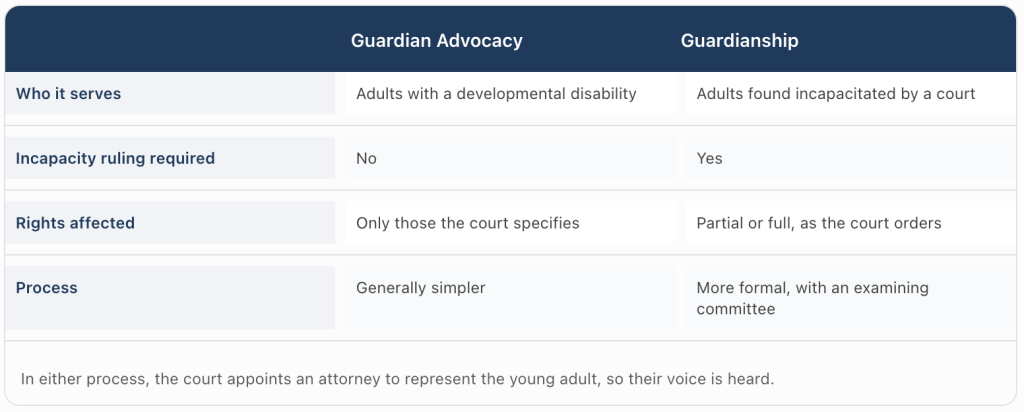
Guardianship and Guardian Advocacy: Two Different Paths
Florida law recognizes that adults with disabilities deserve to keep as many of their rights as possible. That is why the state offers more than one path.
Guardian advocacy is designed for adults with a developmental disability, such as an intellectual disability, autism, cerebral palsy, spina bifida, or Down syndrome. A court can appoint a guardian advocate without first declaring the person incapacitated. It is meant for someone who can make some decisions, but not all of them, on their own. The court decides which specific rights the guardian advocate will help exercise, and the young adult keeps the rest.
Guardianship is a more formal process. It begins with a court determination that a person is incapacitated, either fully or partially. A full guardianship can remove many of a person’s legal rights, so courts treat it seriously and look for the least restrictive option that meets the person’s needs.
You May Not Need a Court Process at All
Many young adults with disabilities can sign legal documents that let a trusted parent help, without going to court. Depending on your child’s abilities, options may include:
- A health care surrogate designation, which names someone to make medical decisions if your child cannot
- A durable power of attorney, which lets a trusted person handle financial and legal matters
- A HIPAA authorization, which allows doctors to share health information with you
- A representative payee, which lets a family member manage Social Security benefits
- A special needs trust or ABLE account, which can protect savings while preserving eligibility for public benefits
These tools work only if your child understands what they are signing. If they do, these options can offer support while preserving independence. In fact, if existing documents already meet your child’s needs, a Florida court may decide a guardian advocate is not necessary.
When Should You Start?
The best time to plan is before your child turns 18, ideally around age 17. Starting early gives your family time to:
- Talk with your child about what decisions they feel comfortable making
- Gather input from teachers, doctors, and care providers
- Choose the right tool, whether that is a legal document, guardian advocacy, or guardianship
- Have documents signed or a court process underway so there is no gap in support
Every family’s situation is different. A conversation with an attorney can help you weigh your child’s independence against their need for support.
We Are Here to Help Your Family Plan
At Gilbert Garcia Group, we guide Tampa Bay families through guardianship, guardian advocacy, and the planning tools that can make court unnecessary. We take the time to understand your child and your goals, and we explain each option in plain language, in English or Spanish.
If your child is approaching 18, call us at 813-443-5087 or visit gilbertgrouplaw.com to schedule a consultation.
This article is for general information only and is not legal advice. Every family’s situation is different.
